Introduction
When a control signal becomes unstable, an encoder drops pulses, or a VFD installation creates noise in nearby circuits, buyers often start by asking for “shielded cable.” That is a useful starting point, but it is not yet a complete specification. The right choice depends on the signal type, cable length, movement, grounding design, jacket environment, and the documentation required in the destination market.
This guide explains how engineers, distributors, panel builders, and procurement teams can compare foil, braid, and foil plus braid shielding for industrial cable projects in the Philippines, Turkey, the Middle East, Europe, the United States, and African markets.
Key Takeaways
- Shielding helps reduce EMI impact, but it should not be described as eliminating all noise.
- Foil, braid, and combination shields solve different buyer problems related to coverage, flexibility, termination, and mechanical durability.
- A quote request should include conductor size, core count, shield type, jacket, flexing condition, grounding expectations, and required documentation.
What a Shield Does in Industrial Cable
A cable shield is a conductive layer used to reduce electromagnetic interference and support signal or drive-circuit performance. In industrial plants, common noise sources include motors, drives, relays, welding equipment, long parallel cable runs, and poorly separated power and signal circuits.
Shielding is especially relevant for:
- Control cables in machinery, panels, and production lines
- Instrumentation cables for measurement, monitoring, and process control
- Automation data cables for sensors, encoders, BMS, PV monitoring, and IoT devices
- VFD motor circuits where electrical noise control and grounding design matter
The shield is only one part of the system. Cable routing, separation from power circuits, grounding, connector choice, cabinet bonding, and installation workmanship can all affect the final result.
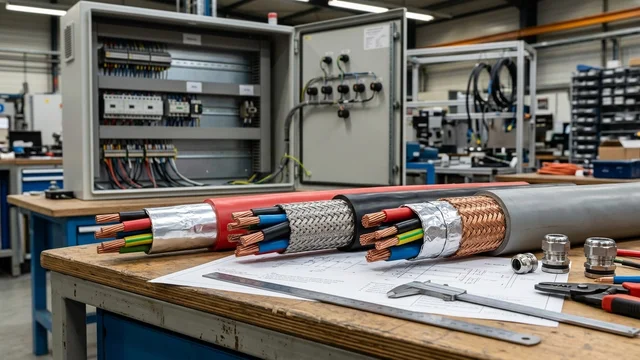
Foil, Braid, or Foil Plus Braid?
| Selection Point | Foil Shield | Tinned Copper Braid | Foil Plus Braid | Buyer Note |
|---|---|---|---|---|
| Typical fit | Compact control and data signal cables | Industrial control, moving equipment, stronger grounding contact | Higher EMI concern applications | Final selection depends on signal type and installation |
| Coverage | Often selected where high shield coverage is needed | Coverage depends on braid construction | Combines two shielding methods | Do not claim a fixed percentage unless confirmed |
| Flexibility | Good for many fixed or lightly flexible routes | Often preferred where mechanical durability matters | Can be less compact than foil alone | Confirm bending and flexing requirements |
| Termination | Often uses a drain wire for easier grounding | Braid can be terminated around connectors or glands | Requires careful termination practice | Grounding method should match the equipment design |
| Cost and production | Usually efficient for many signal cables | May increase material and labor cost | Usually reviewed for more demanding projects | Ask for MOQ and lead time by construction |
For DEV Cable’s DV-FLEX & CONTROL shielded industrial cable series, foil shield, tinned copper braid, and foil plus braid options can be reviewed according to EMI environment, bending needs, budget, and project documentation.
For an equipment interconnect with D-Sub terminations, review our custom D-Sub cable assemblies. Specify the pinout and shield termination together with the cable construction.
Application-Based Selection
Control Panels and Machine Wiring
For control panels, machine tools, and automation cabinets, buyers usually need clear core identification, practical flexibility, and a shield design that fits the grounding plan. Confirm whether the cable will be in a fixed cabinet route, moving machine section, drag chain, or field wiring path.
For fixed control-panel circuits that specify an overall copper tape screen, review our CVV-S control cable. Confirm conductor size, core count, circuit voltage and grounding requirements against the selected construction.
Instrumentation and Process Signals
Instrumentation circuits often need stable measurement signals. Buyers should specify pair, triad, or multi-conductor construction; individual shield, overall shield, or both; drain wire details; jacket environment; and whether low-smoke or fire behavior documentation is required.
VFD and Servo-Related Circuits
VFD cable selection should be handled carefully because the circuit involves drive output behavior, grounding, insulation stress, and installation layout. Do not treat any shielded control cable as automatically suitable for a VFD motor lead. Provide voltage class, drive system, motor lead length, grounding design, jacket exposure, and required standard or listing documents.
BMS, PV Monitoring, and IoT Data Acquisition
For building management, solar monitoring, and industrial data acquisition, buyers often need smaller custom runs, consistent marking, and stable supply. In these cases, a custom shielded cable platform with low MOQ support can help when catalog cables do not match the exact core count, jacket, printing, or packing requirement.
Standards and Compliance Notes
Shielded cable terminology can overlap across regions. North American buyers may request AWG-based constructions or UL style references, while European projects may use LiYCY or LSZH style naming. These terms should not be treated as confirmed listings by default.
For any project in the Philippines, Turkey, the Middle East, Europe, the United States, or Africa, confirm:
- Required voltage rating and temperature rating
- Applicable installation code or project specification
- Flame, smoke, halogen, oil, sunlight, or abrasion requirements
- Whether a listing, test report, declaration, or datasheet is required
- Exact marking, packing, and language documentation needs
DEV Cable can review project specifications around UL2464/AWG style, LiYCY style, LSZH style, or custom construction requirements when confirmed by the final cable design and documentation.
How to Specify When Requesting a Quote
Send the supplier a clear technical request instead of only asking for “shielded cable.”
| Quote Item | What to Provide |
|---|---|
| Application | Control panel, instrumentation, servo, VFD, BMS, PV monitoring, IoT, or machine tool |
| Conductor | AWG or metric size, copper requirement, strand flexibility |
| Cable design | Number of cores, pairs, triads, color code, drain wire |
| Shield | Foil, tinned copper braid, foil plus braid, or not confirmed |
| Jacket | PVC, LSZH style, oil resistance, UV exposure, abrasion needs, color |
| Movement | Fixed, occasional movement, continuous flex, drag chain |
| Market | Philippines, Turkey, Middle East, Europe, United States, or Africa |
| Documentation | Datasheet, test report, packing list, marking, compliance documents |
| Commercial details | Quantity, MOQ expectation, destination port, lead time, packing |
FAQ
Is shielded cable always better than unshielded cable?
Not always. Shielded cable is useful when the application has EMI concerns or signal integrity requirements, but it adds termination and grounding considerations. If the installation is simple and low-noise, unshielded cable may be acceptable when the project specification allows it.
Which is better, foil shield or braid shield?
Neither is automatically better. Foil is often selected for compact signal protection and broad coverage, while braid is often selected where mechanical durability and grounding contact are important. Foil plus braid can be reviewed for higher EMI concern environments.
Can one shielded cable work for control, instrumentation, and VFD applications?
Do not assume that. Control, instrumentation, and VFD circuits have different electrical and installation requirements. The supplier should review the exact circuit, voltage class, cable length, grounding design, and project documentation before recommending a construction.
Does shielding guarantee no interference?
No. Shielding can help reduce EMI impact, but routing, grounding, bonding, connectors, cabinet design, and installation quality also matter.
What should buyers confirm before ordering?
Confirm conductor size, core count, shield type, jacket material, flexing condition, destination market, applicable standard or project specification, marking, documentation, MOQ, and lead time.