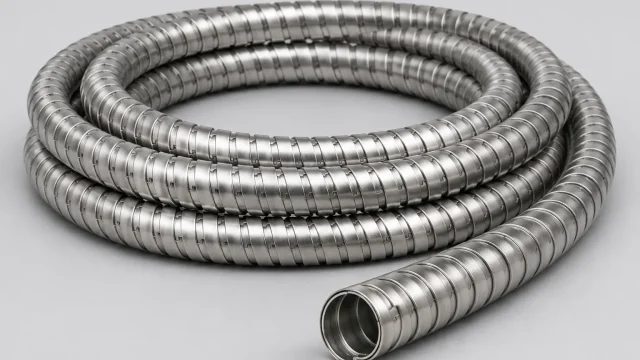
A buyer requests “Flexible Metallic Hose, 16 mm.” That description leaves several decisions open: cable protection or fluid transport, actual inside and outside diameters, material, temperature, environmental exposure, fittings and cable compatibility.
An anonymized industrial boiler-consumables RFQ requested 400 meters of 16 mm metallic flexible hose alongside high-temperature Type K thermocouple cable. A later reference photograph showed a coiled, spiral/interlocked appearance consistent with possible cable-protection conduit. It did not verify construction, alloy, dimensions, wall thickness, sealing, certification or temperature capability. The inquiry illustrates a specification problem, not a completed project.
This guide explains how to turn that starting description into a usable flexible metal conduit specification.
1. What Is Flexible Metal Conduit?
Many flexible metallic conduit designs use metal strip wound into an interlocked helical profile. Adjacent turns allow bending while the metal enclosure protects cables from abrasion and specified mechanical loads. Machinery connections and instrumentation routes benefit from this installation flexibility.
Construction determines performance. Bare interlocked strip does not inherently contain pressure or exclude liquids. ABB’s metallic cable-protection range illustrates distinct constructions and matched fittings rather than one universal conduit specification.
| Type | Main function | Important distinction |
|---|---|---|
| FMC: flexible metal conduit | Electrical cable protection and routing | Verify the specific construction and installation approval; do not assume liquid sealing. |
| LFMC: liquidtight flexible metal conduit | Cable protection with an outer liquid-resistant jacket | Requires compatible liquidtight fittings and suitable installation conditions. |
| Stainless steel interlocked conduit | Mechanical protection in selected corrosive or industrial environments | Alloy alone establishes neither electrical listing nor watertightness. |
| Corrugated stainless steel fluid hose | Fluid or gas containment in a rated assembly | Requires pressure, temperature, media and end-connection specifications. |
Swagelok’s metal-core hose range provides examples of fluid-service constructions. Do not substitute electrical conduit for pressure-rated hose because both look metallic and flexible.
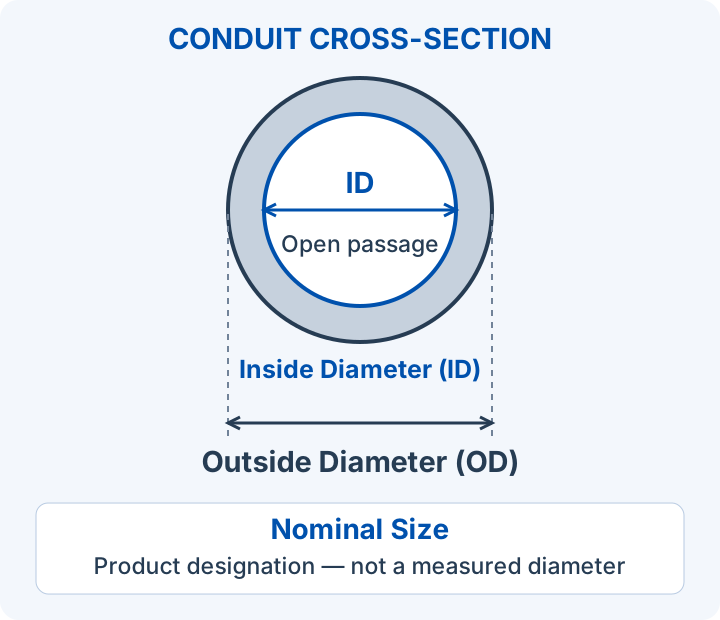
2. Inside Diameter vs Outside Diameter
Inside Diameter (ID)
The flexible metal conduit inside diameter is the internal cable passage. It affects cable clearance, pulling and usable space. Specify the minimum usable bore and tolerance; interlocked profiles are not perfectly smooth tubes.
Outside Diameter (OD)
The flexible metal conduit outside diameter is its external envelope. It matters for clamps, routing clearance and compatible conduit fittings. A jacket changes that envelope. Connector selection also depends on the conduit profile and retention method.
Nominal Conduit Size
Nominal size identifies a product within its sizing system. It need not equal either measured diameter. Flexible metal conduit sizes from different ranges cannot be compared reliably by designation alone.
What Does 16 mm Conduit Mean?
For a verified example, LAPP SILVYN SSUE, article 61804602, publishes:
| Parameter | Manufacturer’s published example |
|---|---|
| Nominal size | 16 |
| Inside diameter | 12.9 mm |
| Outside diameter | 16.4 mm |
| Minimum bend radius | 40 mm |
| Material description | AISI 316 stainless steel |
These are LAPP product values, not universal dimensions or DEV CABLE specifications. A different FMC/LFMC product with metric designator 16 or 1/2-inch trade size may have significantly different physical dimensions. The original 16 mm request does not identify this LAPP product.
For procurement, confirm:
- The manufacturer’s sizing system, product code and drawing revision.
- Minimum ID, maximum OD and tolerances, including any jacket.
- Bend-radius definition, measurement method and fitting compatibility.
3. Galvanized Steel vs 304 vs 316 Stainless Steel
Galvanized Steel
Galvanized flexible metal conduit uses steel with a protective zinc coating. It is an economical candidate for general industrial use in dry indoor conditions. Persistent moisture, damaged coating and aggressive chemicals can make another construction more suitable.
304 Stainless Steel
AISI 304 is a chromium-nickel austenitic stainless steel with good general corrosion resistance. It can suit humid factories, certain outdoor installations and food-processing equipment where exposure and hygiene requirements allow. Outokumpu’s 304 overview describes the alloy family and representative applications. Alloy selection alone does not establish a hygienic conduit system.
316 Stainless Steel
AISI 316 contains molybdenum, improving resistance to chloride-related pitting and crevice corrosion compared with 304. This can help in marine, coastal and certain chemical or washdown environments. It remains vulnerable under sufficiently aggressive conditions. Chloride concentration, temperature, acidity, deposits and crevices all matter, as explained by the British Stainless Steel Association.
Neither alloy has universal chemical compatibility, and 316 is not automatically mechanically stronger than 304. Also, 316 and 316L are distinct grade designations: the L version has lower carbon limits. Confirm the specified grade and material documentation; see BSSA’s grade comparison.
Which Material Should You Choose?
| Material | Corrosion resistance | Typical use to assess | Relative cost* |
|---|---|---|---|
| Galvanized steel | Zinc coating protects steel; aggressive exposure limits suitability | Dry indoor machinery | Usually lower |
| 304 stainless steel | Good general resistance; chloride attack remains possible | Humid factories, suitable outdoor equipment | Usually intermediate |
| 316 stainless steel | Improved chloride pitting/crevice resistance over 304 | Coastal, marine and selected washdown routes | Usually higher |
Qualitative comparison for otherwise comparable constructions; actual quotations depend on design and supply conditions.
4. Bare Flexible Metal Conduit vs Liquidtight Conduit
Bare interlocked conduit offers mechanical protection but is not automatically watertight. Gaps and end connections can admit moisture or contamination.
Liquidtight designs commonly add a nonmetallic outer jacket. Select that jacket for water, oil, coolant, UV exposure and cleaning agents as applicable. A general “liquidtight” description does not establish resistance to every industrial fluid.
For example, Southwire Titan2 Type EF, SPEC60509 combines galvanized steel with a flexible PVC jacket and publishes a −10°C to +60°C operating range. This product-specific example shows why a metal core does not make a jacket suitable for extreme heat. It is not a universal LFMC rating or evidence of DEV CABLE certification.
Verify ingress performance for the complete system: conduit, fittings, seals, connector installation and enclosure interface. Use matched fittings and the manufacturer’s assembly instructions; do not assign an IP rating from appearance.
5. Industrial Applications
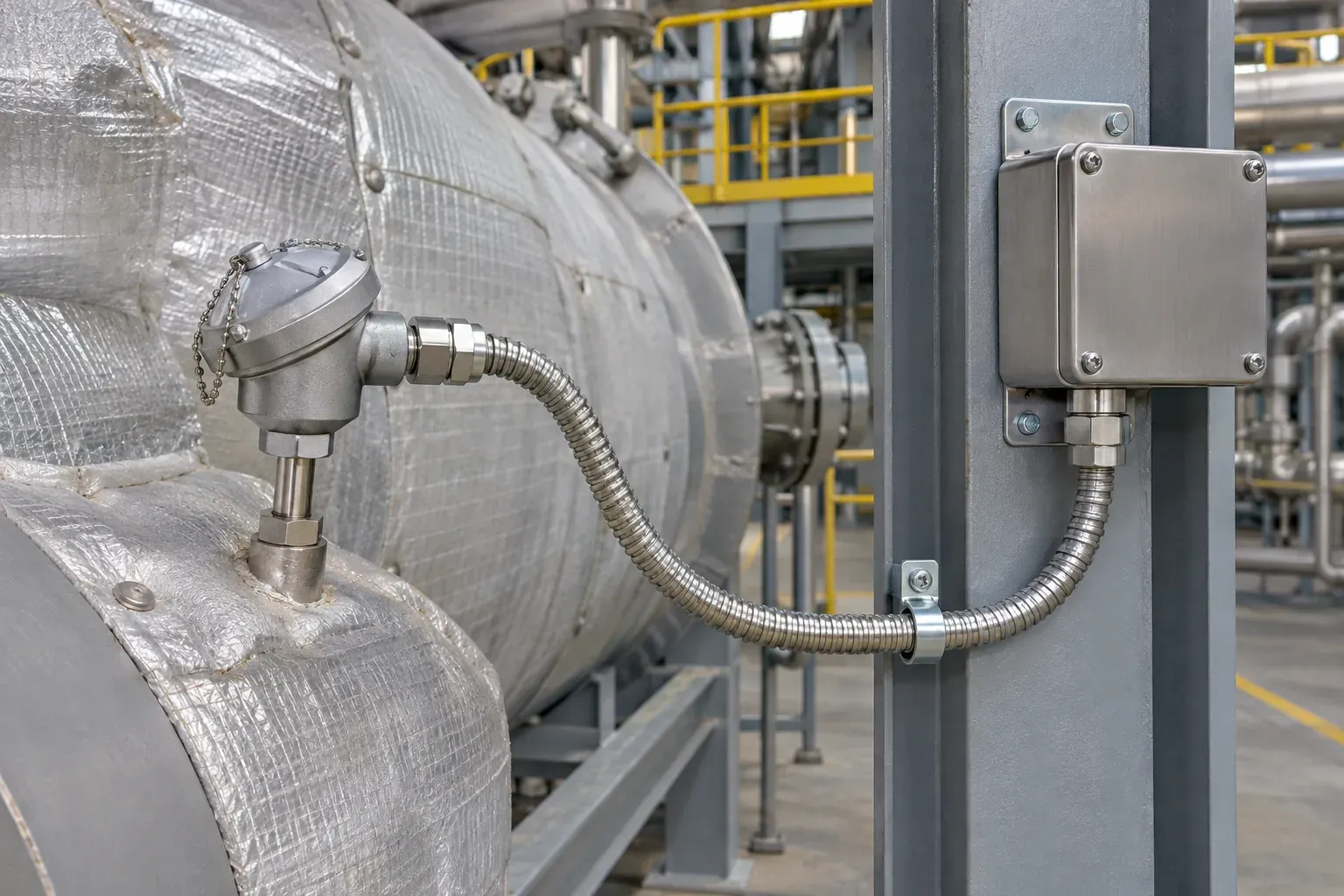
Industrial Boilers and Thermocouple Cables
Flexible conduit can protect boiler instrumentation cables against abrasion and specified mechanical impact. For Type K circuits, check conductor grade and insulation requirements separately from the mechanical covering.
A thermocouple measuring 700°C does not imply its adjacent wiring and conduit operate at 700°C. Assess radiation, hot supports and temperature along the route. Keep transitions in suitable zones and select high-temperature fittings where actual exposure requires them. Neither standard 304 conduit nor ordinary liquidtight conduit should be assigned a 700°C rating without assembly-specific evidence. See the 700°C Type K thermocouple cable guide for the separate cable-selection issues.
Manufacturing Machinery
Equipment connections may need installation flexibility and protection from vibration or rubbing. Review supports, connector retention and clearance from moving parts. A flexible connection still needs defined mechanical duty.
Water Treatment and Chemical Processing
Specify moisture, chemicals, concentrations and cleaning conditions. Review conduit, jacket, fittings and seals together; choosing stainless steel does not resolve every chemical exposure.
Marine and Coastal Applications
Chloride-rich deposits can make 316 preferable to 304. Evaluate salt accumulation, crevices, drainage and maintenance. More resistant materials may be necessary for severe conditions.
Moving Machinery and Repeated Flexing
Occasional installation bending differs from continuous cyclic movement. Obtain dynamic-duty data covering bend radius, travel, speed and cycle requirements. Do not assume every FMC product is suitable for a moving axis.
6. How to Match Flexible Conduit With Industrial Cables
- Determine cable outside diameter. Use finished cable dimensions and tolerances, including braid or sheath. Include every cable in the proposed bundle.
- Determine minimum conduit inside diameter. Allow pulling clearance and account for the usable bore and fitting restrictions. Cable OD alone cannot establish the final conduit size.
- Verify cable fill and installation rules. Apply the adopted code, cable type and installation conditions; avoid a universal fill percentage.
- Check both bending radii. Respect cable and conduit limits, their measurement conventions, and static versus dynamic duty. Allow space at terminations.
- Choose material for the environment. Assess corrosion, temperature, moisture, oils and mechanical exposure.
- Select compatible fittings and threads. Match conduit construction and dimensions as well as enclosure entries: metric, NPT and other thread systems are not interchangeable.
- Review electrical bonding and mechanical requirements. Establish the required fault-current path, bonding arrangements, supports and connector retention.
Metallic conduit is not automatically a guaranteed EMI shield or compliant grounding path. Continuity, joints, bonding and system documentation determine suitability. Follow instrument-specific screening instructions; the K-type extension cable guide discusses the cable-side distinction.
IEC 61386-1 covers general conduit-system requirements; IEC 61386-23 addresses flexible systems. For NEC installations, Articles 348 and 350 cover FMC and LFMC respectively in the 2023/2026 editions, as identified in NFPA’s official article mapping. Confirm the locally adopted edition and product approval. These references do not certify a proposed assembly.
7. Selection Guide by Application
These are starting points for assessment, not universal approvals.
| Application | Possible conduit type | Selection consideration |
|---|---|---|
| Dry indoor machinery | Galvanized FMC | Mechanical duty, supports and fittings |
| Humid factory | Stainless or suitable jacketed conduit | Condensation, drainage and seals |
| Coastal equipment | 316 stainless system | Chlorides, crevices and maintenance |
| Industrial boiler instrumentation | Temperature-suitable metallic protection | Actual route temperature and cable grade |
| Oil/coolant exposure | Chemically suitable liquidtight system | Jacket and seal compatibility |
| Moving machinery | Specifically dynamic-rated system | Radius, travel and validated cyclic duty |
8. What to Include in a Flexible Metal Conduit RFQ
Use a specification checklist to make supplier proposals comparable:
- Function: Electrical cable protection or fluid/gas service.
- Construction: Interlocked or corrugated; required mechanical duty.
- Dimensions: Nominal size and sizing system, ID, OD and dimensional tolerances.
- Material: Exact alloy or galvanized construction; required material evidence.
- Jacket: Bare or jacketed, jacket material and exposure requirements.
- Bending: Minimum bend radius and occasional or cyclic movement.
- Fittings: Conduit interfaces, connector threads, seals and enclosure entries.
- Temperature: Continuous exposure, excursions, duration and hot locations.
- Corrosion environment: Chemicals, chlorides, humidity and washdown conditions.
- Supply: Total quantity, cut lengths, reel/coil packaging and identification.
- Documentation: Datasheet, dimensioned drawing, installation instructions and required test evidence.
- Standards: Applicable standards, editions, installation rules and required approvals.
Attach cable dimensions and a routing sketch. “16 mm metallic hose” leaves the usable bore, connection geometry and service suitability unresolved; even a 400-meter quantity cannot make that description sufficient for procurement.
9. Selecting Cable Protection for Custom Industrial Projects
Start with the cable circuit and route conditions, then review compatible protection. DEV CABLE’s thermocouple extension cable page provides a starting point for custom industrial cable requirements, including conductor arrangements, insulation and shielding. Send the cable schedule and protection requirements together so dimensional, thermal and termination compatibility can be reviewed before quotation.