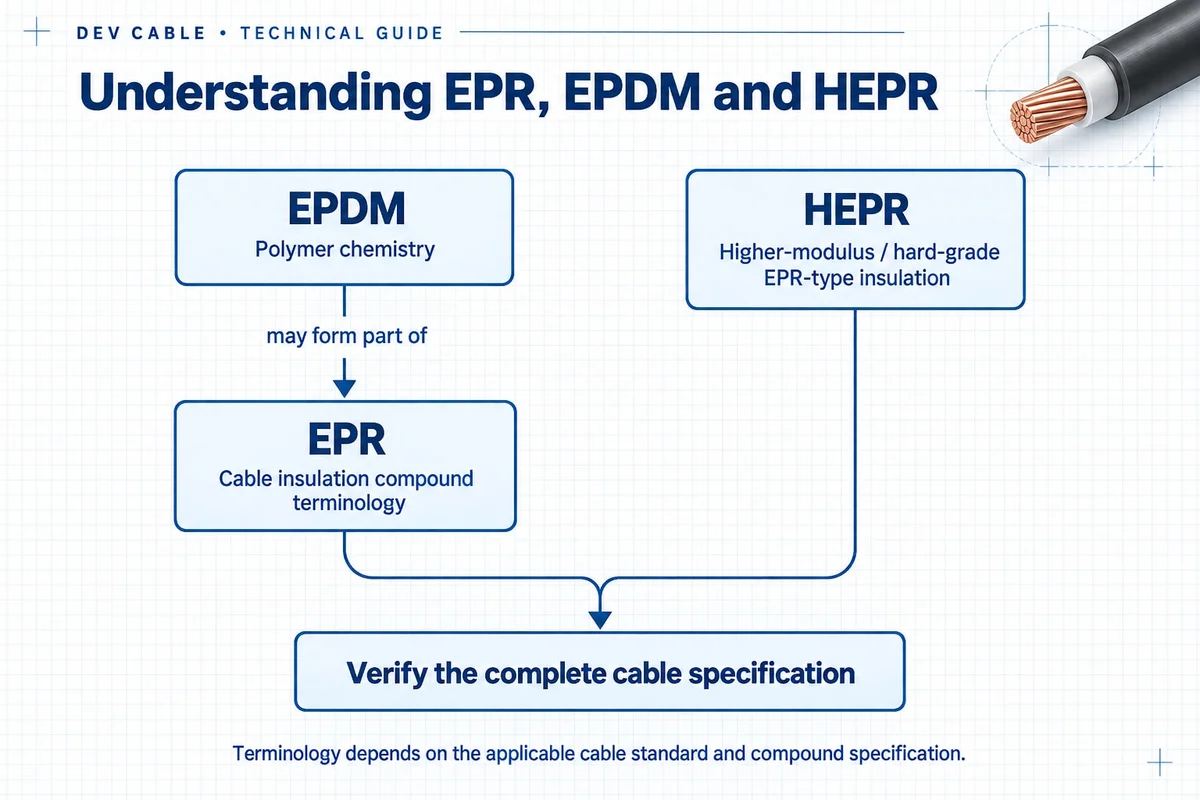
EPR, EPDM and HEPR appear in specifications for power, industrial, marine and pump cables, but they do not describe three independent polymer families. The terms operate at different levels: EPR is widely used for ethylene-propylene rubber insulation compounds; EPDM identifies a polymer chemistry that can be used in those compounds; and HEPR identifies hard-grade EPR insulation in relevant cable specifications.
That overlap matters when comparing quotations. An offer describing “EPDM insulation” may not contradict an enquiry asking for “EPR insulation.” Equally, neither wording establishes that the offered compound meets the required insulation designation, temperature class or electrical tests. A supplier must connect the material description to the specified cable construction.
For buyers, the useful distinction is polymer chemistry → compound formulation → insulation designation → finished cable rating. Each step adds requirements that the previous label cannot establish alone.
The practical question is therefore what the specification means, which compound is qualified, and whether the complete cable meets its electrical, thermal, mechanical and environmental duty. This guide explains how to make that comparison, particularly where flexibility, submerged operation or power-cable construction affects the purchase decision.
EPR vs EPDM vs HEPR at a Glance
Use this table to interpret specifications. Its columns compare terminology and engineering implications, rather than rank three mutually exclusive materials.
| Selection point | EPR | EPDM | HEPR |
|---|---|---|---|
| Meaning | Ethylene propylene rubber; broad cable-insulation terminology | Ethylene propylene diene monomer rubber; a polymer chemistry | Hard-grade ethylene propylene rubber; an insulation designation in relevant specifications |
| Relationship | Describes a family of formulated insulation compounds | Can provide the polymer base for an EPR-type compound | An EPR-type compound category with defined mechanical requirements |
| Cross-linking | Normally cross-linked in the cable insulation discussed here | Cable compounds require a specified formulation and curing system | Cross-linked insulation system |
| Typical positioning | Power and industrial elastomeric insulation | Polymer basis identified in cable compound or product literature | Power-cable systems using higher-modulus insulation |
| Flexibility | Compound and complete construction dependent | Polymer selection contributes; the name gives no cable bend rating | Higher modulus does not, by itself, determine finished-cable flexibility |
| Electrical performance | Verify the qualified insulation system | Verify the formulated compound, not just the base polymer | Verify the designation, voltage class and construction |
| Wet-environment use | Available in specifically qualified constructions | Relevant cable grades exist; no automatic immersion approval | Requires construction-specific evidence |
| Temperature | Assigned by the cable specification | No universal finished-cable temperature from the polymer name | Assigned by the cable specification |
| Wall thickness | Follow the applicable construction requirements | Chemistry alone cannot determine wall thickness | Reduced walls may be possible in defined designs where permitted |
| Essential purchasing evidence | Cable datasheet, standard and test requirements | Connection between polymer description and required compound type | Applicable HEPR requirements and compliant cable dimensions |
The terminology is supported by Prysmian’s discussion of EPR and EPDM in its EPR-insulated submarine cable brochure. Its WindFlex catalogue also provides an example of HEPR insulation used to reduce wall thickness in a defined cable design. These are manufacturer examples, not interchangeable specifications for every cable.
What Is EPR Cable Insulation?
EPR means ethylene propylene rubber. In cable practice, it commonly describes a formulated, cross-linked elastomeric insulation system rather than one fixed recipe. Depending on the specification and manufacturer, the terminology may encompass compounds based on EPM or EPDM chemistry.
The formulation and cure determine how the insulation behaves around a conductor. Fillers, additives and processing must work together to deliver the required electrical and mechanical properties. Naming the base rubber does not identify that complete system.
Cross-linking creates a network that limits flow when the material is heated. This supports thermal dimensional stability, but it does not remove ageing or deformation limits. For a purchasing specification, request the insulation type and applicable tests, including the required evidence for the cured material.
What Is EPDM Cable Insulation?
EPDM is commonly expanded as ethylene propylene diene monomer rubber. It identifies an ethylene-propylene elastomer containing a diene component. EPM refers to the related ethylene-propylene copolymer without that diene component.
EPDM can be a polymer ingredient in a cable insulation compound described commercially as EPR. Consequently, asking whether a cable is “EPR or EPDM” may confuse a compound description with its polymer chemistry.
Polymer selection still matters. ExxonMobil’s electrical and fibre-optics materials information identifies EPDM grades for cable applications and discusses flexibility, electrical properties and ozone resistance. Those properties explain interest in the polymer; they do not qualify every EPDM formulation as electrical insulation.
When an offer says EPDM, ask the supplier to identify the governing cable standard, insulation compound designation, finished-cable rating and supporting technical data. The answer should show whether the offered construction satisfies the enquiry, rather than merely supply a different abbreviation.
What Is HEPR Cable Insulation?
HEPR means hard-grade ethylene propylene rubber in relevant cable terminology. It is associated with higher-modulus EPR-type insulation, rather than a third unrelated polymer family. Modulus describes resistance to deformation under specified conditions; it is not a universal measure of cable quality.
The engineering benefit can include a more compact insulation system. However, a reduced wall is acceptable only where the governing specification and qualified construction permit it. HEPR wording on a quotation is not permission to reduce insulation thickness independently.
A useful comparison therefore asks what changes in the proposed cable: insulation dimensions, overall diameter, bending requirement, electrical qualification and accessory fit. Conventional EPR may remain appropriate where an existing qualified construction already meets the duty. HEPR should be selected for a demonstrated construction benefit, not treated as an automatic upgrade.
Why EPR and EPDM Are Often Confused
The confusion usually comes from comparing different levels of description. One supplier names the polymer; another names the insulation family; a project specification names the required compound category.
The following is a terminology aid, not a universal chemical classification:
| Level | Example | What the buyer still needs |
|---|---|---|
| Polymer chemistry | EPDM | The actual cable compound and cure system |
| Compound formulation | An EPDM-based EPR insulation compound | Its qualified properties and applicable designation |
| Specification designation | EPR or HEPR under the relevant requirements | The required cable dimensions and tests |
| Finished cable | A defined insulated, sheathed cable construction | Ratings, installation limits and supporting documentation |
Consider an RFQ requiring EPR insulation and a quotation offering EPDM insulation. Neither acceptance nor rejection should follow from those words alone. Request a compliance comparison against the required insulation designation and product standard. If the supplier cannot make that connection, the material description remains incomplete.
Main Engineering Differences That Affect Selection
Electrical Performance
Compare qualified insulation systems at the required voltage. Generic dielectric figures for raw polymers cannot establish the voltage rating of a manufactured cable.
For medium-voltage duty, include insulation dimensions, conductor and insulation screens, manufacturing controls, accessories and the required electrical tests. Ask which reports apply to the offered construction and whether the project requires additional testing. Avoid treating a material datasheet as a substitute for cable-level evidence.
Mechanical Properties and Flexibility
A higher-modulus compound and a more flexible cable describe different things. Finished-cable bending depends on conductor stranding, core lay, insulation wall, fillers, shielding, armor, sheath and overall diameter.
Specify whether the cable will be fixed, occasionally moved or continuously flexed. A cable that bends easily during installation is not automatically suitable for repeated reeling, torsion or drag-chain service. Request the permitted bending radius and evidence for the actual motion duty, including the installation temperature.
Thermal Performance and Temperature Ratings
There is no universal equation such as “EPDM = 90°C.” Temperature must be attached to a defined cable, operating condition and specification.
For example, Prysmian’s TowerFlex technical brochure describes particular HEPR-insulated constructions referencing IEC 60502-1 with a maximum conductor temperature of 90°C. This demonstrates a documented cable class; it does not establish a rating for all HEPR compounds or every cable containing EPDM.
Separate continuous conductor temperature from ambient or fluid temperature. Also separate normal operation from any permitted overload or short-circuit condition, whose duration and limits need explicit confirmation. A short-term thermal limit cannot be used as a continuous operating rating.
For sizing, request the current-carrying assessment for the installation. Grouping, surrounding temperature and heat dissipation remain relevant even when two cables carry the same conductor-temperature rating.
Moisture and Submerged Operation
Suitable ethylene-propylene insulation systems can be considered for wet service, but suitability must be established for the complete construction. Wet-location duty and continuous immersion at a specified depth are different procurement requirements.
State the fluid, temperature, immersion duration and depth. Request evidence addressing those conditions, together with the jointing and termination arrangement. A favourable material property does not establish protection against water entering through a damaged sheath or cable end.
Ozone, Weather and Chemical Exposure
EPDM manufacturer literature identifies useful ozone and weather resistance, including in ExxonMobil’s EPDM overview. For an outdoor cable, the exposed sheath and complete installation still require assessment. Internal insulation properties cannot qualify an unspecified outer jacket for sunlight exposure.
Oil and chemical resistance require separate evidence. Identify the actual oil, fuel, cleaning agent or process fluid, its concentration, temperature and exposure duration. Do not translate “rubber insulation” into a universal resistance claim. Check which layer was tested and what acceptance criteria applied.
Insulation Thickness, Processing and Accessories
Compare construction drawings when cable diameter matters. A permitted reduction in insulation wall may change core dimensions, yet shielding, sheath and armor can still determine the final outside diameter.
Confirm that glands, joints and terminations fit the offered dimensions. For MV systems, include the accessory manufacturer’s insulation-diameter and interface requirements. A compact cable that falls outside an approved accessory range may create additional work or require a different accessory.
Processing also belongs in qualification: an acceptable formulation must be manufactured and cured consistently. For example, IEC 60811-507 provides a hot-set test procedure for cross-linked materials. The applicable product specification establishes how the relevant test requirements are used.
Which Insulation System Should You Choose?
Start with the cable duty and required specification, then evaluate the material description offered against it.
| Application or requirement | Terminology that may be encountered | Selection priority |
|---|---|---|
| LV or MV power distribution | EPR or HEPR insulation | Voltage class, dimensions, electrical tests and compatible accessories |
| Marine or offshore installation | Defined elastomeric insulation and sheath types | Applicable cable standards, fire requirements and specified environmental tests |
| Industrial flexible cable | EPR or EPDM-based compounds | Defined movement, bending, pulling and sheath requirements |
| Reeling or mechanically demanding power cable | EPR or HEPR in purpose-designed constructions | Qualification of the complete moving cable, rather than modulus alone |
| Submersible pump | EPR/EPDM-type insulation in suitable designs | Fluid, depth, duration, motor entry, joints and mechanical support |
| Motor leads | Specified elastomeric insulation | Temperature, routing, electrical duty and connection method |
| ESP and downhole service | EPDM/EPR among construction-specific options | Well conditions, barriers, armor, MLE and termination system |
Prysmian’s mining cable product mapping illustrates the use of both EPR and HEPR in different demanding cable constructions. It supports application-specific comparison, rather than assigning one insulation label to an entire industry.
EPR, EPDM and HEPR in Submersible Pump Cables
For a submersible pump, the decisive requirement is dependable operation of the specified cable and connections in the actual fluid. An EPR or EPDM description alone cannot establish that requirement.
Begin with the route from the power supply to the motor. Record the total length, submerged length, motor load, starting method and any sections operating outside the water. Identify the pump entry and whether a joint will remain submerged. These details help turn a material request into an assessable cable specification.
Then define the water environment. A clean-water borehole, a wastewater pit and a process-fluid pump should not share an undefined “waterproof cable” requirement. Give the fluid composition, temperature, depth, expected immersion duration and any cleaning chemicals or contaminants.
Water resistance is a system issue involving:
- Insulation and sheath selected for the duty.
- Fillers and water-blocking measures where required.
- Sealed joints, motor entries and terminations.
- Protection against installation damage.
- Cable support and control of mechanical loads.
Flexibility helps installation only when the cable also fits the available space, permitted bend radius and connection arrangement. Confirm support details for vertical runs; do not assume the electrical cable can carry the pump’s weight.
DEV CABLE’s Submersible Pump Cable page provides an application-led starting point for specifying the motor, immersion conditions and cable entry. The ordered construction still needs its own agreed requirements.
What About ESP and Downhole Cable?
An ESP cable requires a well-specific system review. EPDM/EPR terminology is only one part of that review, and it cannot establish compatibility with hydrocarbons, gas or downhole pressure.
Provide the operating temperature profile, pressure, well fluids, relevant gas composition and decompression conditions. Review the insulation together with any required metallic barrier, protective layers, armor, splices, motor lead extension and pothead interface. Check the available clearance and handling conditions as well as the electrical load.
The DEV CABLE ESP Cable and MLE product page identifies several insulation-system options for evaluation. Their presence does not mean that every option suits every well. A quoted construction should explain how it addresses the specified environment and motor interface.
How Do These Systems Compare with XLPE and Fluoropolymers?
XLPE is cross-linked polyethylene; EPR and HEPR describe ethylene-propylene elastomeric insulation systems. Both families appear in power-cable engineering. Compare flexibility, dimensions, electrical qualification, manufacturing requirements and accessories for the actual application. For the broader conventional-material comparison, see PVC vs PE vs XLPE Cable Insulation.
Fluoropolymer insulation addresses a different set of potential requirements, including specialized thermal, chemical, dielectric or thin-wall duties. Its selection also depends on the grade and finished construction. The ETFE vs FEP vs PFA Cable Insulation Guide explains that comparison; a fluoropolymer is not an automatic replacement for a qualified elastomeric cable system.
What Should Buyers Specify in an RFQ?
“EPDM cable, three core” is insufficient for an accurate technical quotation. Give the supplier enough information to define the conductor, insulation, protective layers and evidence required for acceptance.
| RFQ topic | Information to provide |
|---|---|
| Conductors | AWG or mm², material, stranding class, core count and protective-earth or control-core requirements |
| Electrical duty | Rated voltage, load current, motor starting method and total route length |
| Temperature | Continuous conductor requirement, ambient or fluid temperature, and any overload or short-circuit conditions with duration |
| Installation | Fixed, occasional-flex or continuous-flex; routing, support, pulling, bending and movement requirements |
| Environment | Indoor/outdoor, sunlight, water type, immersion depth and duration, oil, fuel, chemicals or drilling fluids |
| Construction | Required insulation designation, sheath, shielding, armor, water blocking and dimensional limits |
| Connections | Gland or motor-entry dimensions, joints, terminations and any MLE interface |
| Compliance | Applicable IEC, EN, UL or project specification, required edition, certification scope and test documentation |
| Supply | Total quantity, individual lengths, drum or packing requirements, marking and destination |
Ask the supplier to list deviations and unresolved inputs. If the enquiry requires a defined compound type, the offer should explicitly confirm that type or explain the proposed alternative. Review the final datasheet and construction drawing against the RFQ before approval.
Technical Reference Note
This guide uses primary technical sources to distinguish material terminology, documented construction examples and standards scopes:
- IEC 60502-1:2021: construction, dimensions and testing for extruded-insulation power cables at rated AC voltages of 1 kV and 3 kV for fixed installations.
- IEC 60502-2:2014, with Amendment 1:2024: the corresponding power-cable scope from 6 kV to 30 kV. Apply the edition and amendments required by the project.
- IEC 60092-360:2021: requirements for insulation and sheath materials used in shipboard and offshore-unit cables. This material standard does not independently approve a complete cable for every marine duty.
- IEC 60811-100:2012 and relevant individual parts: non-metallic cable-material test methods. Examples include IEC 60811-401 for air-oven thermal ageing and IEC 60811-507:2012 for hot-set testing. Confirm applicable amendments and the product standard’s acceptance criteria.
- Prysmian EPR submarine, WindFlex and TowerFlex literature, linked above: terminology and specific construction examples. Historical catalogues illustrate engineering approaches; obtain a current datasheet for an actual purchase.
- ExxonMobil EPDM and electrical-application literature, linked above: polymer and cable-compounding context, rather than finished-cable ratings.
Public IEC catalogue descriptions establish scope and publication identity; they do not replace the full standards. Detailed compliance must be checked against the project-required documents. No cited standard is a blanket endorsement of a polymer or evidence of DEV CABLE certification. A material datasheet is not a finished-cable rating.
Specify the Construction Behind the Abbreviation
EPR describes a cable-elastomer family, EPDM identifies polymer chemistry, and HEPR identifies hard-grade EPR insulation in relevant specifications. Turn those descriptions into an agreed compound designation, cable construction, rating and set of acceptance requirements.