Introduction
Selecting a fluoropolymer insulation is not simply a question of choosing the material with the highest temperature rating. A cable engineer or buyer must also consider chemical exposure, abrasion, flexibility, dielectric performance, cable diameter, installation conditions and cost. A resin that performs well in a laboratory property table may still be unsuitable when combined with the conductor, shield, sheath, armor and termination required by the application.
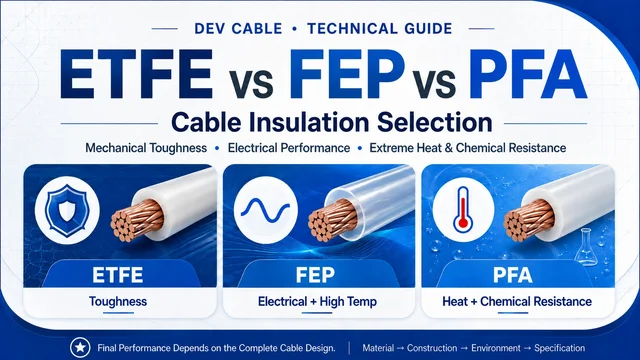
ETFE, FEP and PFA are all melt-processable fluoropolymers, but they are not interchangeable. ETFE cable insulation is often considered for mechanical toughness, FEP cable insulation for a useful balance of electrical performance and high-temperature capability, and PFA cable insulation for more demanding thermal and chemical duty. The practical question is not which polymer is “best,” but which material supports the complete cable construction without unnecessary over-specification.
ETFE vs FEP vs PFA at a Glance
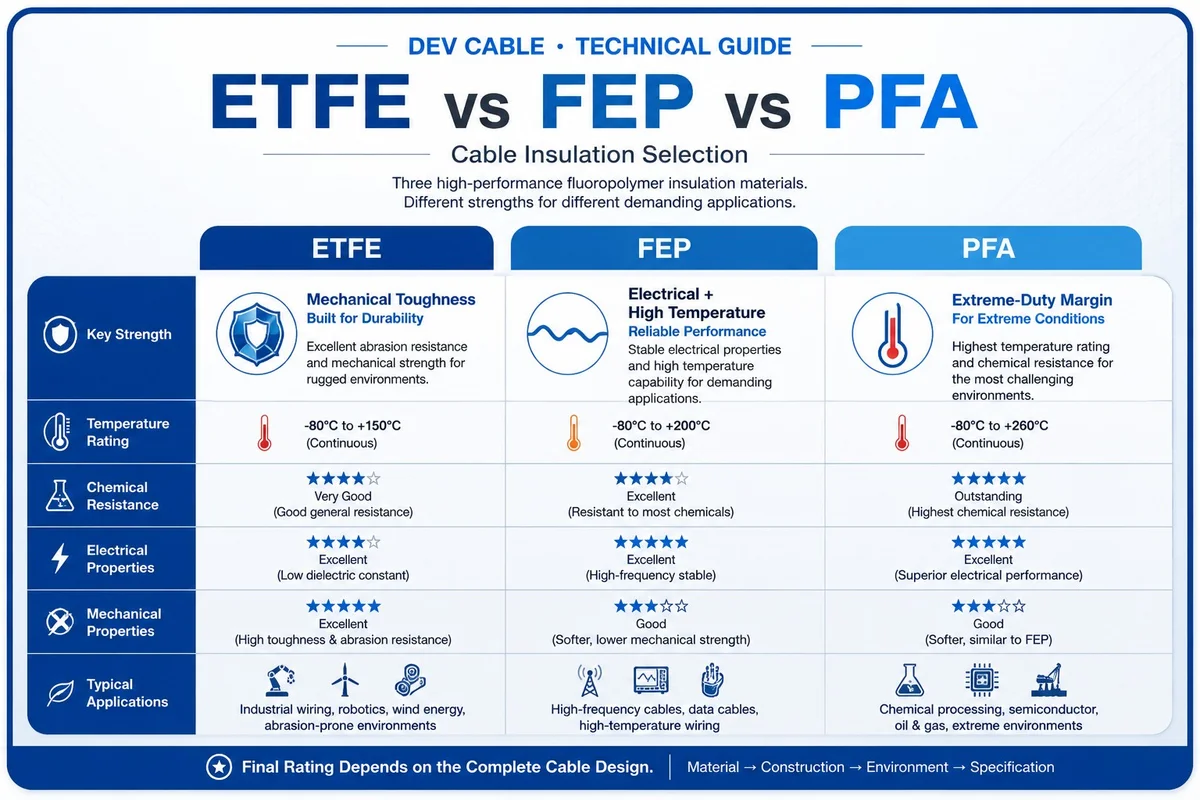
| Property | ETFE | FEP | PFA |
|---|---|---|---|
| Polymer family | Partially fluorinated copolymer | Fully fluorinated copolymer | Fully fluorinated copolymer |
| Typical material capability | Approximately up to 150°C, depending on grade | Approximately up to 200°C, depending on grade | Approximately up to 260°C, depending on grade |
| Mechanical toughness | Excellent | Good | Very good |
| Abrasion resistance | Excellent | Good | Very good |
| Flexibility | Good; grade and wall dependent | Very good | Very good; grade and wall dependent |
| Chemical resistance | Very good | Excellent | Excellent |
| Electrical insulation | Very good | Excellent | Excellent |
| High-frequency dielectric performance | Very good | Excellent | Excellent |
| Weather resistance | Excellent | Excellent | Excellent |
| Processing / extrusion | Melt processable; useful for robust thin walls | Melt processable; cable grades support thin-wall, high-speed extrusion | Melt processable; processing control can affect cost |
| Relative material cost | Moderate for a fluoropolymer | Moderate to high | Generally high |
| Typical cable applications | Equipment wire, transportation, industrial and mechanically demanding wire | High-temperature wire, coaxial, data, signal and instrumentation cable | Extreme-temperature wire, chemical-duty and specialized high-frequency cable |
Note: These are representative polymer service-temperature ranges, not automatic temperature ratings for a finished cable. The allowable cable operating temperature depends on the specific resin grade, cable construction, conductor temperature, applicable standard and service environment.
What is the main difference between ETFE, FEP and PFA? ETFE is often chosen for mechanical toughness and abrasion resistance; FEP for stable dielectric performance, flexibility and high-temperature wire insulation; and PFA for the highest thermal and chemical performance margin among these three. Every comparison depends on the resin grade and the finished cable design.
What Is ETFE Cable Insulation?
ETFE means ethylene tetrafluoroethylene. For cable design, its important distinction is the combination of fluoropolymer environmental resistance with a mechanically robust insulation wall.
Mechanical Strength and Abrasion Resistance
ETFE is often selected where mechanical toughness is a major design priority. Its tensile, cut-through and abrasion behavior can suit compact equipment wires that face pulling, contact with hardware or repeated handling. Actual wall thickness and conductor geometry still matter, so a material-family comparison cannot replace finished-wire testing.
Chemical and Environmental Resistance
ETFE grades can resist many industrial chemicals, oils, fuels and outdoor conditions. Compatibility is not universal: concentration, temperature, exposure time, pressure and mechanical stress can change the result. Buyers should identify the actual media rather than specify only “chemical-resistant cable insulation.”
Electrical Properties
ETFE provides stable electrical insulation and useful dielectric properties for equipment, signal and specialized cable designs. FEP or PFA may be preferred where minimum dielectric loss is the dominant requirement, while ETFE can be attractive when electrical insulation and mechanical durability must be balanced.
When ETFE Makes Sense
ETFE is often a strong candidate when abrasion is important, a thin cable wall must remain mechanically robust, chemical exposure exists, and extreme PFA-level temperature capability is unnecessary. The final selection should confirm the grade, required voltage, bend condition and finished-cable standard.
What Is FEP Cable Insulation?
FEP means fluorinated ethylene propylene. It is a melt-processable fluoropolymer used in wire and cable grades where chemical resistance, flexibility, electrical stability and elevated-temperature performance must coexist. High-flow grades can support efficient extrusion of thin-wall FEP wire insulation, subject to the conductor and process design.
Why FEP Is Used in High-Frequency Cable
FEP is valued for low dielectric loss and electrical properties that remain comparatively stable over frequency. This makes it a common candidate for coaxial cable, data and signal cable, and instrumentation cable. A high-frequency cable engineer must still control conductor geometry, insulation concentricity, shielding, impedance and connector transitions; the polymer alone does not determine system performance.
FEP cable grades are also used for high-temperature wire where PFA’s additional thermal margin is not required. Flexibility depends on the grade, insulation thickness and complete construction, so it should be evaluated on the finished sample rather than assumed from the polymer name.
What Is PFA Cable Insulation?
PFA means perfluoroalkoxy polymer. It combines melt processability with very high temperature capability, excellent electrical characteristics, weather resistance and broad chemical resistance. PFA is normally considered when the application genuinely requires a higher thermal or chemical performance margin.
That margin has a procurement consequence. PFA material cost is generally higher, and manufacturing or process requirements can raise total cable cost. Selecting PFA without a verified need can create over-specification. PFA provides advantages for certain extreme environments, but the highest-performing material is not automatically the most appropriate cable material.
ETFE vs FEP vs PFA: What Are the Main Differences?
Choose ETFE When Mechanical Durability Matters
ETFE often leads the first screening when abrasion, cut-through resistance or robust thin-wall construction drives the design. It may reduce the need to buy a higher-temperature resin solely to obtain a durable fluoropolymer insulation system.
Choose FEP When Electrical Performance and High-Temperature Flexibility Matter
FEP is often shortlisted for high-frequency, signal and instrumentation cables, and for high-temperature equipment wire that does not need PFA-level thermal margin. Its balance of extrusion capability, dielectric behavior and flexibility can be more relevant than maximum temperature alone.
Choose PFA for the Most Demanding Thermal and Chemical Environments
PFA becomes a stronger candidate as continuous temperature, chemical severity or the required safety margin moves beyond the practical range of the other options. Confirm that adjacent cable layers and terminations can operate under the same conditions. The final choice should be based on the complete cable system, not the insulation polymer in isolation.
How to Choose ETFE, FEP or PFA Cable Insulation
This table is a preliminary material-screening guide, not a substitute for cable engineering review.
| Requirement | Material Usually Considered | Why |
|---|---|---|
| High abrasion resistance | ETFE | Often offers the strongest mechanical screening case |
| Thin-wall high-frequency insulation | FEP / ETFE, depending on design | Balances dielectric needs, extrusion and mechanical wall strength |
| High-frequency coaxial cable | FEP / PFA | Low-loss electrical behavior; geometry remains critical |
| Very high operating temperature | PFA | Provides the highest typical material temperature capability of the three |
| Aggressive chemical environment | FEP / PFA, depending on chemistry and temperature | Compatibility must be checked against the actual media |
| Mechanical toughness | ETFE | Commonly selected for abrasion and cut-through priorities |
| Extreme thermal plus chemical duty | PFA | Offers additional combined performance margin |
| Cost-sensitive fluoropolymer design | Engineering review required | The lowest resin price may not produce the lowest compliant cable cost |
How Do ETFE, FEP and PFA Compare with PVC, PE and XLPE?
PVC, PE and XLPE are widely used, economical insulation or sheathing materials for a large range of power, control and industrial cables. They should not be displaced by a fluoropolymer unless the operating requirement justifies it. For example, an XLPE-insulated industrial cable with a PVC jacket may be appropriate for conventional tray and exposed-run duty, while EPR, HEPR or EPDM pump-cable insulation addresses a different combination of water resistance and flexibility.
| Material family | Typical positioning | Relative cost | Typical reason for selection |
|---|---|---|---|
| PVC / PE / XLPE | General power, control and equipment cable | Lower | Established, economical constructions across broad applications |
| Fluoropolymers | Specialized high-temperature or aggressive-duty cable | Higher | Temperature, chemicals, dielectric performance or robust thin walls |
Fluoropolymer cable insulation usually enters the discussion when temperature, aggressive chemicals, demanding dielectric behavior, thin-wall construction or a specialized industrial environment exceeds what a conventional design can provide. For general-purpose polymer insulation, see our PVC vs PE vs XLPE Cable Insulation Guide.
Why Polymer Temperature Rating Is Not the Same as Cable Temperature Rating
Raw polymer continuous service temperature is not the same as finished cable continuous conductor temperature. A manufacturer datasheet describes a specific resin grade under defined test conditions. A cable rating must account for heat generated by the conductor and how the entire construction ages electrically, mechanically and chemically.
The final rating can be limited by the exact resin grade, insulation thickness, conductor material and temperature, adjacent layers, jacket or sheath, shielding, armor, termination, voltage stress, installation environment, cable standard and certification requirement. A 260°C value on a PFA resin sheet therefore does not establish that a PFA-insulated cable may continuously operate at 260°C.
Never specify an entire cable only by saying, “Use PFA because it withstands 260°C.” A useful RFQ states continuous and peak temperature, peak duration, voltage, conductor size, media or chemicals, flexing duty and applicable standard. The cable manufacturer can then review temperature class, insulation thickness, accessory compatibility and the evidence needed for the finished rating.
Typical Applications of ETFE, FEP and PFA Insulated Cables
High-Temperature Equipment Wiring
ETFE, FEP or PFA may be selected for heaters, ovens, sensors and compact equipment wiring, depending on conductor temperature, routing, bend radius and required approval. Hot spots and termination limits must be included in the review.
Instrumentation and Sensor Cables
Fluoropolymer insulation can be considered where process chemicals, heat, small diameters or stable electrical behavior matter. Pairing, shielding, capacitance targets and the sheath often influence the decision as much as the primary insulation.
Coaxial and High-Frequency Cables
FEP and PFA are common candidates for high-frequency cable insulation; ETFE can also be considered where mechanical durability has greater weight. Impedance and attenuation depend on the whole coaxial geometry, materials and production tolerances.
Chemical Processing Equipment
FEP, PFA or ETFE may support cables exposed to corrosive process areas. The engineer should identify every chemical, concentration, temperature, exposure mode and cleaning agent, then verify both insulation and outer-sheath compatibility.
Oil & Gas and Downhole Applications
In an ESP cable and motor lead extension system, fluoropolymer selection cannot be based on temperature alone. Well temperature and pressure, oil, gas, decompression, well-fluid chemistry, mechanical protection, any required lead or metallic barrier, armor, MLE interface and termination design must be reviewed as one system. ETFE, FEP or PFA may be considered in specialized layers or constructions, but none should be described as the universal ESP insulation.
What Should Buyers Include in a Fluoropolymer Cable RFQ?
Provide enough information for the supplier to connect material properties to a manufacturable cable construction:
- Conductor size in AWG or mm², conductor count and material
- Voltage rating, continuous operating temperature and maximum short-term temperature with duration
- Chemical, oil, fuel, gas or cleaning-media exposure
- Indoor or outdoor use; fixed, occasional-flex or continuous-flex installation
- Minimum bending requirement, shield, jacket or sheath, and cable outside-diameter limit
- Applicable cable standard, certification and required technical documents
- Total length, individual packing lengths, packaging and destination
Specifying only “FEP cable” or “PFA cable” is not sufficient for an accurate quotation. If some inputs are unknown, identify them as open engineering points rather than allowing the resin name to become the entire specification. Buyers can also review the cable sourcing FAQ or compare DEV CABLE’s custom cable products before preparing the RFQ.
Technical Reference Note
The temperature and property positioning in this guide is based on representative manufacturer literature, including the Chemours Tefzel ETFE 200 product information, Daikin NEOFLON FEP NP-3180 datasheet, Daikin NEOFLON PFA AP-Series information and Chemours Teflon PFA 340 product information. Material datasheet values are grade-specific and typical values may not be suitable as finished-cable specification limits. Always use the current resin supplier datasheet and verified cable specification for design approval.
FAQ
What is the difference between ETFE, FEP and PFA cable insulation?
ETFE is often selected for mechanical toughness and abrasion resistance. FEP is commonly considered for flexible high-temperature wire, thin-wall extrusion and high-frequency dielectric performance. PFA provides the highest typical thermal capability and a strong chemical-resistance margin among these three. Grade, wall thickness and complete cable design can change the final decision.
Which has the highest temperature resistance: ETFE, FEP or PFA?
PFA generally has the highest representative material service-temperature capability, followed by FEP and ETFE. Typical manufacturer literature may show approximately 260°C, 200°C and 150°C respectively for relevant grades. These figures describe raw materials, not guaranteed finished-cable conductor ratings.
Is ETFE better than FEP for cable insulation?
Not universally. ETFE may be the better candidate where abrasion, cut-through resistance or mechanical durability dominates. FEP may be more appropriate where high-frequency dielectric behavior, flexibility or a higher material temperature class has priority. The application determines which trade-off is useful.
Is FEP suitable for high-temperature wire?
Yes, suitable FEP cable grades are widely used for high-temperature wire insulation, but the allowable temperature must be assigned to the finished wire or cable. The conductor, insulation wall, adjacent layers, sheath, terminals, installation and governing standard must all support the stated rating.
When should PFA insulation be used?
PFA should be considered when verified continuous temperature, chemical exposure or combined thermal-chemical duty requires more margin than an ETFE or FEP design can provide. Its higher material and processing cost means the requirement should be demonstrated rather than assumed from a preference for the highest temperature number.
Are ETFE, FEP and PFA better than XLPE?
They are not inherently better. XLPE is economical and effective in many power and industrial cable constructions. Fluoropolymers become relevant when a design needs higher temperature capability, specialized dielectric performance, chemical resistance or thin, mechanically durable walls that the selected XLPE construction cannot provide.
Can fluoropolymers be used for oil and gas cables?
They can be considered for certain oil and gas, instrumentation and downhole cable constructions. Selection depends on well or process temperature, pressure, chemicals, hydrocarbons, gas decompression, barriers, armor, electrical stress and terminations. A fluoropolymer name alone does not qualify a cable for oil and gas service.
Conclusion
In ETFE vs FEP vs PFA cable insulation selection, ETFE is often attractive for mechanical toughness and abrasion resistance; FEP for high-temperature electrical and high-frequency applications; and PFA for the most demanding thermal and chemical environments. Translate those material strengths into conductor, insulation, shield, sheath, armor, termination and compliance requirements before issuing a purchase specification. The correct choice is the material that satisfies the complete cable operating requirement without unnecessary over-specification.