Introduction
Insulation separates energized conductors and helps the cable meet its electrical, thermal and mechanical duties. The selected material influences dielectric behavior, allowable conductor-temperature class, cable diameter, flexibility, moisture response, flame and smoke behavior, installation limits, service reliability and total cost. Yet the polymer name is only one design input. Compound formulation, conductor construction, insulation thickness, shield, jacket, manufacturing controls, installation and the governing cable standard can change the result.
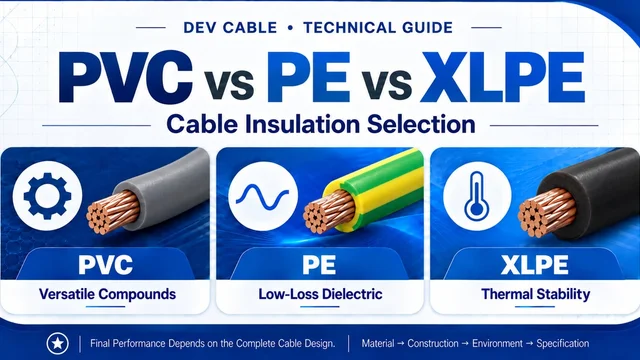
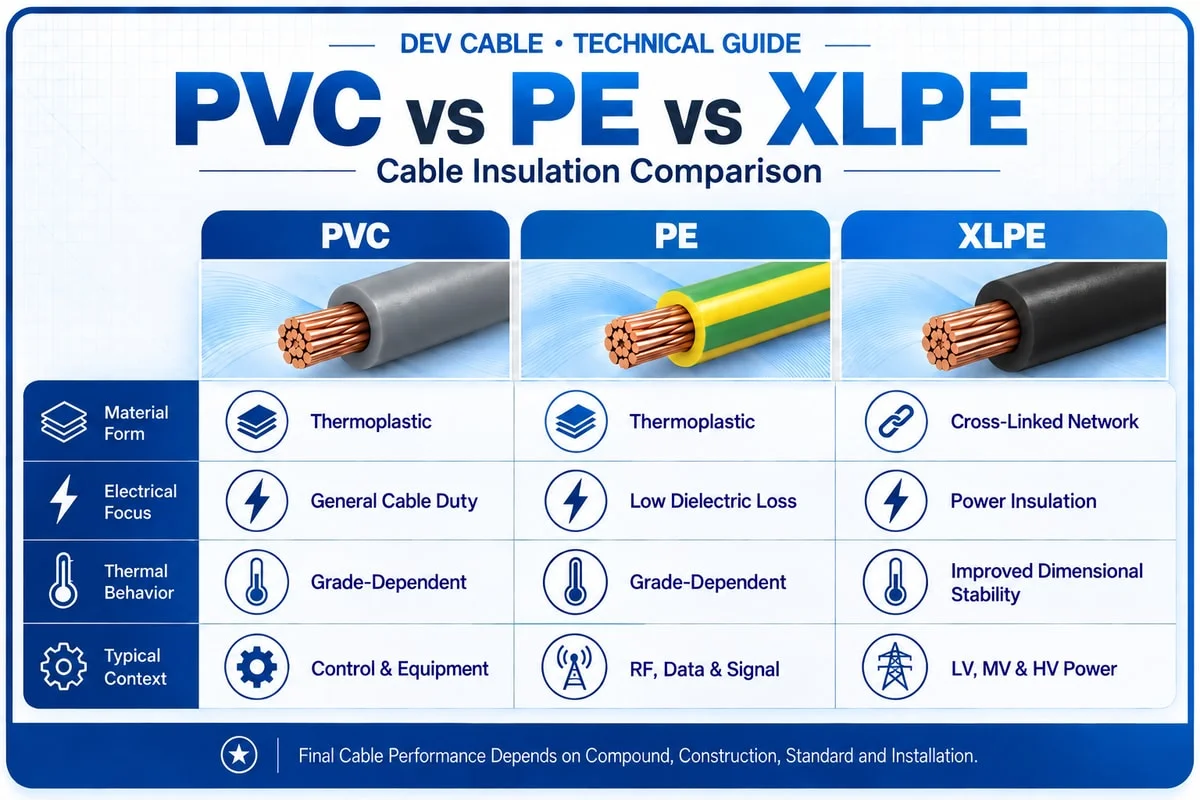
Direct answer: PVC, PE and XLPE solve different cable-engineering problems. PVC is a versatile chlorine-containing thermoplastic used in economical insulation and jacket compounds. PE is a thermoplastic polyolefin known for useful dielectric and moisture characteristics. XLPE begins as polyethylene, then cross-linking creates a network that improves thermal dimensional stability and supports many power-cable designs. There is no universally “best” insulation material; the correct choice depends on the complete cable design and operating environment.
PVC vs PE vs XLPE at a Glance
This comparison is a screening tool. Terms such as “good” or “higher” describe common engineering positioning, not guaranteed values for every compound or finished cable.
| Property | PVC | PE | XLPE |
|---|---|---|---|
| Full name | Polyvinyl chloride | Polyethylene | Cross-linked polyethylene |
| Polymer family | Vinyl polymer | Polyolefin | Cross-linked polyolefin |
| Material behavior | Thermoplastic | Thermoplastic | Cross-linked network polymer |
| Electrical insulation | Good for many general cable duties; grade-dependent | Very good; widely considered where dielectric behavior matters | Very good; widely used in power insulation systems |
| Dielectric loss | Generally higher than suitable PE cable grades | Generally low; grade and construction dependent | Low to moderate depending on compound and system |
| Moisture resistance | Compound- and construction-dependent | Generally very good | Generally very good; not a claim that the cable is waterproof |
| Thermal stability | Grade-dependent; many established cable classes | Grade-dependent; thermoplastic deformation remains a design consideration | Improved resistance to thermal deformation after cross-linking |
| Flexibility | Highly adjustable through formulation | Density, grade and wall dependent | Compound, cross-linking, wall and cable construction dependent |
| Mechanical performance | Good general-purpose range | Density and formulation dependent | Good thermal-mechanical stability; grade dependent |
| Flame behavior | Can be engineered with established flame-retardant compounds | Base polymer is combustible; requires a defined fire-performance system | Base polymer is combustible; requires a defined fire-performance system |
| Halogen content of base polymer | Contains chlorine | Halogen-free | Halogen-free |
| Typical cable use | Control, building wire, equipment wire, insulation and jackets | Coaxial, RF, data, signal, telecom insulation and some sheaths | LV, MV and HV power cable; industrial cable |
| Relative material / processing cost | Generally lower | Generally moderate | Generally higher due to compound and cross-linking process |
Compound formulation, insulation thickness, conductor construction, cable standard and the complete cable design matter in every row. A table cannot assign ampacity, voltage rating, flame classification or service life from the polymer family alone.
What Is PVC Cable Insulation?
PVC means polyvinyl chloride. It is a thermoplastic supported by mature cable-compounding and extrusion technology. Plasticizers can adjust flexibility; fillers, stabilizers, pigments and flame-retardant packages can change processing, ageing, mechanical and fire behavior. “PVC insulation” therefore describes a family of compounds, not one fixed property set.
PVC is used for both insulation and outer sheaths. Its economical processing, broad formulation range and established specifications make it practical for many control, equipment and general-purpose cables. Flexible PVC can suit applications where routing and handling matter, while other formulations prioritize heat ageing, oil resistance or flame performance. Those properties must be verified for the requested grade and finished construction.
Chlorine is part of PVC polymer chemistry. Under fire conditions, PVC materials can release hydrogen chloride and other halogen-containing combustion products, creating corrosive-gas and smoke concerns. That is more accurate than the broad statement “PVC is toxic”: fire risk depends on formulation, quantity, burning conditions, installation and the relevant test criteria.
DEV CABLE’s PVC-insulated CVV-S control cable is a practical construction example: it uses PVC for both conductor insulation and outer sheath in a conventional fixed control-cable system. This does not mean every PVC compound or every control cable has the same rating.
What Is PE Cable Insulation?
PE means polyethylene, a thermoplastic polyolefin. Cable engineers work with multiple PE types rather than one universal grade. LDPE and LLDPE emphasize different balances of processability, toughness and flexibility, while MDPE and HDPE move toward higher density and stiffness. Additives, molecular structure and processing further change cable performance.
Suitable PE grades provide strong electrical insulation, comparatively low dielectric loss and low moisture absorption. These properties explain PE’s importance in coaxial, RF, data, signal and telecommunications cables, where dielectric behavior can affect attenuation and impedance control. PE is also used in selected cable sheaths. Geometry, insulation uniformity, foaming where specified, shielding and connector design remain as important as the resin family.
The PE base polymer contains no halogens, but a halogen-free polymer is not the same thing as a finished LSZH cable. Additives, flame-retardant systems, binders, fillers, jackets and other layers must be considered. The finished cable must meet the project’s low-smoke, halogen and flame-test requirements before LSZH or HFFR language is justified.
What Is XLPE Cable Insulation?
XLPE means cross-linked polyethylene. It starts with polyethylene, but the manufacturing system creates bonds between polymer chains. The resulting three-dimensional network restricts chain movement, so the material resists flow and dimensional deformation at elevated temperature more effectively than ordinary thermoplastic PE.
That structural change helps explain XLPE’s widespread use in power-cable insulation. Useful electrical properties, thermal stability and mechanical performance can support low-, medium- and high-voltage systems, subject to the correct compound, cross-linking process, insulation thickness, screens, accessories and standard. XLPE is not restricted to MV or HV cable; many LV industrial and power constructions also use it.
Cross-linking adds material-control and processing requirements, so XLPE is not simply “better PE.” Peroxide, silane and other cross-linking approaches create different manufacturing considerations. Cleanliness, curing, by-products, degassing where relevant and process verification can affect the final insulation system and cost.
The current DEV CABLE XLPE-insulated TC-ER cable page shows stranded copper conductors, XLPE insulation and a PVC jacket. It is one construction example, not a claim that every TC-ER cable must use those materials.
PVC vs PE vs XLPE: Main Differences
The main differences are the polymers’ chemistry, thermoplastic or cross-linked behavior, electrical positioning, fire-system implications and processing. The application turns those material differences into cable requirements.
Electrical Performance
PVC compounds provide adequate dielectric performance for many general-purpose, control and equipment cables. Suitable PE grades are frequently chosen for coaxial, RF and communications work because of comparatively low dielectric loss. XLPE combines useful electrical insulation with thermal stability, making it an important power-cable insulation family.
None of these statements fixes impedance, attenuation, voltage class or ampacity. Conductor geometry, insulation thickness and uniformity, screens, manufacturing tolerances, ambient conditions and the cable standard control the finished result.
Thermal Performance
PVC, PE and XLPE respond differently to heat, but simple formulas such as “PVC = 70°C” and “XLPE = 90°C” are unsafe specifications. Many finished PVC cable constructions are associated with 70°C conductor classes, and many XLPE power cables with 90°C classes, but other classes exist. The material grade, insulation system, ageing tests, conductor temperature, installation, overload or short-circuit conditions and governing standard must support the declared rating.
Polymer capability is not the same as finished-cable rating. Ampacity also depends on conductor material and size, ambient temperature, grouping, installation method and the surrounding thermal environment.
Moisture and Environmental Resistance
PE and XLPE generally have low water absorption and useful moisture performance. Neither makes a cable waterproof. Radial and longitudinal water ingress depend on the sheath, water-blocking layers, cable construction, joints, terminations, damage and installation. Outdoor selection also requires UV, temperature, oil, chemical and mechanical review.
PVC environmental behavior varies substantially with formulation. A compound suitable for an indoor control cable should not be assumed suitable for sunlight, immersion, oil exposure or direct burial without evidence from the finished specification.
Mechanical Properties and Flexibility
“PVC is flexible, PE is rigid and XLPE is medium” is too crude for procurement. Flexible PVC depends heavily on plasticizer and formulation. PE stiffness changes with density and grade. XLPE behavior changes with compound, cross-link density and insulation wall.
At cable level, conductor stranding, core lay, insulation thickness, fillers, shield, braid, armor, jacket, overall diameter and operating temperature can dominate bend behavior. State whether the cable is fixed, occasionally flexed or continuously flexed rather than asking for a polymer to supply undefined flexibility.
Fire, Smoke and Halogen Behavior
PVC contains chlorine; PE and XLPE base polymers do not contain halogens. Those facts do not determine complete fire performance. A flame test measures a defined specimen under defined conditions, while smoke and halogen-acid tests measure different hazards. Passing one test does not automatically establish another property.
PE or XLPE is not automatically LSZH or HFFR. The compound formulation, flame-retardant package, all relevant cable components and finished-cable test results must support the claim. Future guidance can address LSZH, HFFR and XLPO systems in detail; no unverified placeholder page is linked here.
PVC vs XLPE Cable: Which Should You Choose?
Choose between PVC and XLPE by matching the construction to the project, not by assuming XLPE is a universal upgrade. PVC remains appropriate for many cost-sensitive general-purpose and control cables. Its compound flexibility and mature processing can be advantageous where the specified temperature, electrical and installation duties are moderate.
XLPE becomes attractive when a power-cable duty, thermal margin, electrical requirement or resistance to thermal deformation justifies its material and processing demands. It can support LV as well as MV and HV systems. The decision must also consider flexibility, cable diameter, jointing, accessories, jacket choice, fire and smoke requirements, certification and installed cost.
A project can legitimately specify XLPE insulation with a PVC jacket. The insulation primarily manages electrical separation and thermal duty around each conductor; the jacket primarily protects the assembled cable during installation and service. The two layers solve different problems.
PE vs XLPE: What Does Cross-Linking Change?
PE and XLPE share polyethylene chemistry, but cross-linking changes how the polymer chains respond to heat and stress. Thermoplastic PE softens and can flow as temperature rises. The molecular network in XLPE limits that movement, improving dimensional stability and resistance to thermal deformation.
This helps position PE for low-loss communications and signal insulation and XLPE for many power-cable systems. It is not a clean electrical ranking: PE grade, XLPE compound, insulation geometry and frequency all matter. Cross-linking also adds manufacturing stages and quality controls, which can increase cost. The useful question is whether the application needs the network structure, not whether XLPE sounds more advanced.
Which Cable Insulation Material Should You Choose?
Start with the operating duty and governing specification. This is a screening guide, not a substitute for the project cable specification.
| Application / Requirement | Material Often Considered | Why / Qualification |
|---|---|---|
| General fixed control cable | PVC | Established, economical compound systems; confirm rating and environment |
| Cost-sensitive LV cable | PVC or project-dependent alternative | Total construction and standard decide suitability |
| Coaxial, RF or data cable | PE | Low dielectric loss can support signal performance; geometry remains critical |
| Low dielectric loss | PE | Select an appropriate grade and validate the complete transmission design |
| Industrial power cable | XLPE | Useful electrical and thermal-mechanical balance |
| Higher thermal margin | XLPE | Cross-linking improves resistance to thermal deformation |
| MV power cable | XLPE or EPR, per specification | Insulation system, screens, accessories and standard are decisive |
| Fire-sensitive occupied area | Engineered LSZH/HFFR system review | Base-polymer name alone cannot establish compliance |
| Very high temperature or aggressive chemicals | Fluoropolymer review | Specialized duty may justify a different material family |
How These Materials Appear in Real Cable Constructions
Example 1 — TC-ER: XLPE Insulation with a PVC Jacket
DEV CABLE’s displayed TC-ER construction uses stranded copper, XLPE insulation and a PVC outer jacket. The XLPE layer addresses the conductor’s insulation and thermal requirements. The PVC jacket addresses handling, mechanical and environmental duties for the assembled cable. The marking, listing, installation rules and complete project specification still need confirmation.
Example 2 — CVV-S: PVC Insulation with a PVC Sheath
The displayed CVV-S construction uses PVC insulation and a PVC sheath. A mature PVC system remains practical for many conventional fixed control-cable applications where its electrical, mechanical, temperature and installation characteristics meet the specification. Using one polymer family in both layers does not make the functions of insulation and sheath interchangeable.
Insulation and jacket are different engineering layers. A cable described casually as “XLPE cable” may contain XLPE only around the conductors, followed by fillers, binder or shield and a different jacket polymer. An RFQ should specify insulation material and sheath or jacket material separately. Buyers can compare these constructions across the DEV CABLE product range.
How Do PVC, PE and XLPE Compare with ETFE, FEP and PFA?
PVC, PE and XLPE cover broad control, communications, industrial and power applications. ETFE, FEP and PFA enter more specialized reviews involving higher temperature, aggressive chemicals, demanding dielectric behavior or robust thin-wall construction. The ETFE vs FEP vs PFA Cable Insulation Guide compares those fluoropolymers without turning them into automatic replacements for conventional materials.
What Should Buyers Specify Besides the Insulation Material?
An accurate RFQ connects material selection to a buildable, testable cable. “XLPE cable, 4 core” normally does not provide enough information for technical quotation. Include:
- Conductor size in AWG or mm², conductor material and core count
- Voltage and required continuous conductor-temperature class
- Short-term, overload or short-circuit conditions where applicable
- Installation method: tray, conduit, open air, duct, buried or another defined route
- Fixed, occasional-flex or continuous-flex duty and minimum bend requirement
- Indoor or outdoor location, UV exposure, water and humidity conditions
- Oil, fuel, chemicals, cleaning agents or other environmental exposure
- Shield, armor, filler, binder and sheath or jacket requirements
- Flame, smoke and halogen requirements with applicable test references
- Applicable IEC, UL, BS, EN, JIS or project specification
- Required certification, marking and technical documentation
- Overall-diameter limit, quantity, individual cable or drum length, packaging and destination
If a requirement is unknown, mark it for engineering review. Do not replace it with a polymer name. The cable sourcing FAQ can help procurement teams structure initial questions. DEV CABLE’s quotation commitment applies after receipt of a complete RFQ, and every finished cable or cord length receives 100% continuity testing before shipment.
Technical Reference Note
These references define cable-system scopes or test methods; they are not generic endorsements of a material:
- IEC 60502-1:2021 covers construction, dimensions and tests for extruded-insulation power cables at 1 kV and 3 kV, while IEC 60502-2:2014 with Amendment 1:2024 covers 6 kV to 30 kV systems.
- IEC 60811-100:2012 provides general requirements for the IEC 60811 test-method family for non-metallic cable materials; individual parts address defined tests.
- IEC 60332-1-2:2025 defines a vertical flame-propagation procedure for a single insulated wire or cable. It does not by itself predict grouped-cable behavior.
- IEC 60754-1:2011 with Amendment 1:2019 addresses halogen acid gas evolved from cable compounds, and IEC 61034-2 addresses smoke density from burning cables under defined conditions.
Use the edition required by the project and its complete product standard. Material-family descriptions and typical industry positioning are not specification limits.
Conclusion
PVC vs PE vs XLPE cable insulation selection is a system decision. PVC offers versatile and economical compound options for many control and general cable duties. PE is important where dielectric loss and moisture behavior support communications, RF or signal designs. XLPE adds a cross-linked network that improves thermal dimensional stability and supports many power-cable systems. Select the conductor, insulation, shield, jacket, tests, installation and standard together rather than treating one polymer as universally superior.